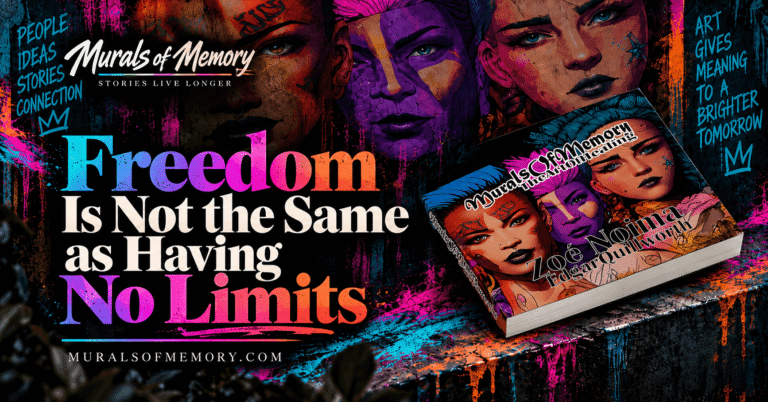
Existential philosophy becomes interesting the moment freedom stops sounding romantic. It is easy to praise choice when the options are attractive. The harder question is what freedom means when every option carries a cost, when history has already shaped the room, when other people can be hurt by what we decide, and when refusing to choose changes the outcome anyway. Murals of Memory: The Art of Healing repeatedly places artists inside that pressure. They are not free because nothing limits them. They are free because, within real limits, they still have to decide what kind of response will become theirs.
The Popular Version of Freedom Is Too Easy
Freedom is often imagined as open space: no rules, no obligations, no one telling you what to do.
That picture is incomplete.
A person can have thousands of options and still feel trapped. Another person can face serious limits and still make a choice that changes the meaning of the situation.
The deeper philosophical issue is not the number of options available. It is ownership.
Can I recognize the choice I am making? Can I admit what it costs? Can I accept that not choosing is also a position? Can I live with the consequences without pretending someone else authored them entirely?
This is why existential questions about life often become uncomfortable. They remove the fantasy that there is always a clean path waiting to be discovered.
Sometimes every path contains loss.
Sometimes courage is choosing without certainty.
Freedom Begins With Seeing the Situation Clearly
Before responsibility can exist, a person has to see what is actually happening.
That sounds obvious, but people are remarkably skilled at hiding from the facts of their own lives. They rename fear as patience. They call avoidance “waiting for the right time.” They describe resentment as loyalty. They blame circumstances for choices they are quietly making every day.
Existential thinking asks for a harder form of honesty.
What are the conditions I did not choose?
What part of this situation is still mine to answer?
That distinction keeps freedom from becoming either fantasy or defeatism.
You are not responsible for everything that happens to you.
You are responsible for what becomes yours to do next.
Case One: Marian Hale and the Freedom to Sign a Hidden Name
Marian’s story in Simon James Duffy’s manuscript is a strong example of constrained agency. She works in a world where women are tolerated as models or muses but not easily respected as intellectual or artistic equals. To publish, she uses the name “M. Hale.” A publisher praises the sharpness of her mind without knowing the author is a woman. She carries that praise in a locket because it proves that her thinking was valued when her identity was hidden.
This is not freedom in a simple sense. Marian does not choose the prejudice around her. She does not choose the professional risk attached to being known fully.
Yet she still acts.
When the locket goes missing and is later recovered, she eventually writes her real name, “I am Marian Hale,” places it inside the locket, and seals it into the back of a self-portrait that will publicly bear the safer name. Her signature exists inside the work even when the world cannot yet receive it openly.
The scene complicates easy ideas about authenticity.
Was Marian dishonest because she used a pseudonym? Or was the pseudonym a survival strategy inside an unfair structure? Is courage always public disclosure? Or can courage sometimes mean preserving the truth until exposure no longer guarantees destruction?
Freedom here is not limitless self-expression. It is the intelligent protection of selfhood under pressure.
Responsibility Is Not the Same as Blame
This distinction is essential.
Blame looks backward and asks who caused the harm.
Responsibility can look forward and ask who is now able to respond.
They may involve the same person, but they often do not.
A child is not to blame for the family they were born into. A grieving person is not to blame for the death that changed them. A worker is not to blame for every economic condition shaping their choices. A person who has been deceived is not to blame for another person’s dishonesty.
Still, at some point, life may hand that person a painful responsibility: decide what happens next.
This is where the meaning of life philosophy becomes less about abstract purpose and more about moral authorship. A meaningful life is not necessarily one in which events make sense. It may be one in which a person refuses to surrender all authorship simply because they did not choose the opening chapters.
Choice Creates Identity in Small Repetitions
People often imagine identity as something hidden inside them, waiting to be discovered.
There is truth in that. Temperament, history, desire, memory, culture, and relationship all shape who we are. But identity is also enacted.
A person who values honesty but repeatedly lies to avoid discomfort is building one identity through action and describing another through intention.
A person who says art matters but never makes time to create is revealing a hierarchy of values, whether or not they like the hierarchy.
A person who says a relationship matters but refuses every difficult conversation is choosing distance through repetition.
This is why introspection and self discovery should not stop at self-description. Reflection matters when it reveals the gap between the self we imagine and the self our habits are producing.
One honest question can be more useful than a hundred personality labels:
What do my repeated choices say I believe?
Case Two: Marek and the Choice to Continue Without Guarantees
Marek paints a man pushing a boulder made of clocks. He thinks of Sisyphus and of strangers carrying invisible burdens through the city. He sees the absurdity of effort in a world where time erodes nearly everything. He doubts grand claims about permanent meaning. Still, he returns to the canvas.
His position is important because it removes one excuse people often use for inaction: “I will commit once I know it will matter.” That knowledge rarely arrives.
No artist knows which work will survive. No parent knows how every decision will shape a child. No partner knows whether love will last for decades. No activist knows whether a protest will change policy. No student knows whether the subject they study will become their life’s work. No person beginning again after loss knows whether the new life will feel worth the effort.
Choice happens before proof. That is why it is a choice.
Consequence Is What Makes Freedom Real
Freedom without consequence would be closer to fantasy than human life. Every meaningful choice closes other possibilities.
To commit to one person is not to live all possible relationships. To build one career is to spend time that cannot be spent in every other profession. To tell the truth may cost approval. To protect peace may cost access to people who prefer chaos. To create seriously may require sacrificing comfort, money, or certainty.
A choice becomes real because something is at stake.
This is also why responsibility should not be treated as punishment. Responsibility is the recognition that our decisions enter a shared world.
My freedom touches other people. My silence can affect them. My promises create expectations. My neglect has consequences. My courage can create space for someone else.
This relational dimension connects existential freedom to the human condition. We are individuals, but never isolated individuals. We act inside networks of memory, dependence, love, power, need, and expectation.
Case Three: Dorian and Isolde Choose Presence Over Performance
Dorian and Isolde inhabit a studio filled with screens, alerts, and people who are technically connected but emotionally distant. They wonder whether they are performing intimacy rather than living it. Their relationship develops not through a dramatic declaration but through attention. Eventually Dorian reaches for Isolde’s hand, and for a brief moment the noise of devices falls away.
Their choice looks small. That is why it matters. Existential responsibility is often hidden inside small acts that never become public stories.
Put the phone down. Tell the truth. Stay for the conversation. Do not send the cruel message. Apologize without adding a defense. Leave when staying requires betraying yourself. Show up when someone has stopped expecting anyone to come.
Big identities are built from ordinary decisions.
Bad Faith: The Stories We Tell to Escape Ownership
One of the most useful existential ideas is that people often escape the discomfort of freedom by pretending they have no choice at all.
Sometimes that is true. Circumstances can genuinely remove options.
But sometimes “I had no choice” means “I did not like the cost of the other choices.”
Those are different statements.
Consider the difference between:
“I could not speak safely in that room.”
and
“I did not speak because I feared being disliked.”
Both can be painful. Only one accurately describes the limits.
Responsibility begins when language becomes precise enough to stop hiding the decision.
A practical exercise is to replace “I have to” with “I am choosing to” and see where the sentence becomes uncomfortable.
“I am choosing to stay in this job because financial stability matters to me right now.”
“I am choosing not to confront this person because I am afraid of the conflict.”
“I am choosing to postpone the project because rest matters more this month.”
Sometimes the revised sentence brings relief. Sometimes it exposes avoidance. Either way, it restores clarity.
Freedom Also Requires Accepting What Cannot Be Controlled
There is a limit to the language of choice.
Not everything is chosen.
Illness is not always chosen. Grief is not chosen. Discrimination is not chosen. Accidents are not chosen. Other people’s decisions are not chosen. The past is not available for revision.
A mature philosophy of freedom must include limitation, or it becomes cruel.
That is where the philosophy of reality enters the discussion. Reality includes both agency and fact. We can interpret, respond, create, resist, or adapt, but we cannot make every condition disappear through mindset.
The strongest form of freedom may therefore be double awareness:
This is what I cannot change.
This is what is still mine to decide.
Both sentences are necessary.
What Responsible Freedom Looks Like in Practice
Responsible freedom is less dramatic than people expect. It often looks like this:
- naming the real cost of a decision before making it
- refusing to call fear “fate”
- recognizing when another person’s freedom is affected by your choice
- distinguishing guilt from responsibility
- changing direction when new evidence makes an old choice indefensible
- accepting that commitment closes other possibilities
- allowing uncertainty without using uncertainty as an excuse for paralysis
- taking ownership of repair when your actions cause harm
This is not a formula for perfect decisions. There are no perfect decisions in a complicated life.
It is a way to choose without abandoning awareness.
The Point Is Not to Become Completely Self-Sufficient
Freedom is often confused with needing no one.
That idea is emotionally attractive and philosophically thin.
People need language they did not invent, care they cannot provide entirely for themselves, social structures they did not build alone, and relationships that change what they are capable of seeing.
Even the artist working privately uses tools, symbols, traditions, materials, and techniques inherited from others.
The self is never made from nothing.
Responsibility therefore includes receiving influence without surrendering judgment.
We can learn from other people without becoming copies of them. We can inherit traditions without treating every inherited idea as sacred. We can accept help without giving away authorship. We can love people without making them responsible for creating our identity.
That balance is harder than either total dependence or total independence.
An Unfinished Life Is Still an Authored Life
The characters in Murals of Memory rarely receive final resolution. They continue making, questioning, remembering, failing, connecting, and revising. That is more philosophically honest than a neat conclusion in which every conflict proves useful.
A life can remain unfinished and still be deeply authored. Freedom is not the power to guarantee an outcome. It is the power, where real choice exists, to participate in what happens next.
Choice is not proof that every option is fair. It is the recognition that some response still belongs to us. Responsibility is not accepting blame for the whole world. It is accepting ownership of the part that carries our name.
That is a demanding vision of freedom, but it is also a humane one. It leaves room for circumstance without turning people into objects. It leaves room for agency without pretending people control everything.
And it asks the question that matters after every theory is finished: Given what is true, what will you do now?
FAQs
What is the main idea behind existential freedom?
Existential freedom is the idea that human beings have to make choices and take responsibility for those choices regardless of the fact that certainty is not available. It does not mean that people can control every circumstance. A more realistic way of reading this is to acknowledge limits but then ask what responses, commitments, and actions are still truly possible within those limits.
Why is responsibility so important in existential thought?
Because choice affects identity and others. If liberty means anything, decisions must matter. Responsibility is about owning the consequences, not pretending that choices exist in a vacuum. And it means fixing the mess when you can and being honest about why a decision was made, especially when it was made out of fear or convenience.
Can existential thinking help with difficult life decisions?
Yes, especially if there is no obviously perfect choice. It can help by separating fact from fear, figuring out what is actually in your control, naming the costs of each choice, and asking which decision best reflects the person you want to become. It doesn’t eliminate uncertainty, but it can help make uncertainty more manageable.
Is choosing not to act still a choice?
Often, yes. Waiting, remaining silent, staying in a situation, or postponing a decision can all influence what happens next. There are cases where circumstances genuinely prevent action, so this idea should not be used to blame people unfairly. The useful question is whether inaction is imposed or whether it is an unacknowledged decision.
How can someone practice more responsible freedom in everyday life?
Start by using precise language. Instead of saying “I have no choice,” identify the options and their costs. Notice repeated behaviors, because patterns often reveal values more clearly than intentions. Before important decisions, ask who will be affected, what you can repair if things go wrong, and whether fear is disguising itself as inevitability.


